Archetypes

Five ways to build over a field

Every design starts with a structure, and each one shares light between modules and plants differently: overhead, on its edge, on a turning axis, as a roof that sheds rain, or as the roof of a tunnel. Each plate below is drawn to true scale from the archetype's default specification, with the sun where it stands at 33.9° S.

AOpen · fixed tilt

Overhead stilted, fixed

Fixed tables on stilts, high enough to farm and drive under. The best-evidenced archetype: the Heggelbach research plant in Germany is built this way.

Clearance
4.5 m2.1–5.0
Row pitch
9.5 m7–12
Tilt to the equator
12°8–20
Ground cover ratio
0.300.2–0.4
Machinery under it
2.5 m wide · 3.0 m high
Plate A · north–south sectionSolar noon · both solstices · 33.9° S
Read the plate

In midsummer the sun is high and each table's shadow sits almost under it. In midwinter it stretches south across the next bed. The studio follows that shadow through every month.

Choose it when

Machinery has to work under the array and the crop needs open ground. A 2.1 m variant suits hand-tractor plots.
COpen · vertical bifacial

Vertical bifacial E–W fence

Vertical bifacial fences facing east and west, with wide lanes between them. The lightest touch on the field: about five per cent of the ground is covered.

Height to the top
2.5 m
Row pitch
10 m8–20
Ground cover ratio
0.050.02–0.1
Machinery width
3.5 m3.0–6.0
Bifacial rear side
on by default
Plate C · east–west section09:00 solar time · 21 March · 33.9° S
Read the plate

A fence takes the morning sun on one face and the afternoon sun on the other, so its shadow swings across the lane and is thinnest at noon.

Watch out

Within 20° of the equator the sun is mostly overhead and a fence gives up 15–30 % of its energy against a tilted array. There the studio treats C as advisory only.

DOpen · single-axis tracking

Single-axis tracker, wide rows

Trackers that follow the sun on wide inter-rows, with backtracking. Their angle is a choice, so they can also turn away and give light back to the crop.

Hub height
2.5 m2.1–4.0
Row pitch
9.5 m9–12
Rotation
±55°50–60
Ground cover ratio
0.300.2–0.4
Power density
0.7 MWp/ha0.5–0.9
Plate D · east–west section09:00 solar time · 21 March · 33.9° S
Read the plate

At 9 a.m. the trackers turn east to face the sun and their shadows fall long to the west across the lanes. By noon they lie nearly flat and the shadow sits under the row.

Fits

Lowland vegetables and maize–rice rotations on flat ground. The tracker figure further down puts the rotation policy in your hands.

ECovered · canopy

PV rain-shelter / fruit canopy

A semi-transparent canopy that takes the place of the plastic rain shelters used over cane fruit, highland strawberry, chili and leafy greens in tropical rain.

Clearance
3.0 m2.5–4.0
Module transmittance
0.400.3–0.5
Ground cover ratio
0.700.55–0.8
Film it replaces
200 µm PE · 3-yr life
Power density
1.0 MWp/ha0.6–1.2
Plate E · north–south sectionSolar noon · both solstices · 33.9° S
Read the plate

The roof is continuous, so it sheds rain like the shelter it replaces, and the beds under it are evenly shaded rather than striped. It can need more irrigation than the open field.

Against your plastic

The studio compares the canopy with an open field, a rain shelter or a tunnel, and prices the film spend avoided over 25 years.

FCovered · tunnel

PV polytunnel / greenhouse roof

PV strips over the film of a tunnel or greenhouse roof. The default is set for South African strawberry tunnels, where about 600 ha of the crop already grows under plastic.

Gutter height
4.5 m3.5–6.0
Roof under PV
25 %10–40
Module transmittance
0.400.3–0.6
Film
200 µm PE · 2-yr life
Power density
0.3 MWp/ha0.15–0.5
Plate F · section across the tunnelsSolar noon · both solstices · 33.9° S
Read the plate

Only part of each roof carries modules. The rest stays film, so most of the tunnel keeps its light and the strips put moving bands of shade across the crop.

Not modelled yet

The microclimate inside the enclosure is not yet modelled. Light, energy and water are; air temperature and humidity under the film are not.

SpecSide by side

Defaults and ranges

ParameterAOverheadCFenceDTrackerECanopyFTunnel
Geometry
Clearance / hub / gutter4.5 m2.1–5.00.5 m lower edge0.3–1.52.5 m2.1–4.03.0 m2.5–4.04.5 m3.5–6.0
Row pitch9.5 m7–1210 m8–209.5 m9–123.5 m3–58 m4–12
Tilt or rotation12°8–2090°60–90±55°50–600°0–105°0–15
Ground cover ratio0.300.2–0.40.050.02–0.10.300.2–0.40.700.55–0.80.250.1–0.4
Light and cover
Module transmittance0000.400.3–0.50.400.3–0.6
Film under the PV———200 µm PE3-yr life200 µm PE2-yr life
Yield and work
Power density0.55 MWp/ha0.4–0.80.4 MWp/ha0.2–0.60.7 MWp/ha0.5–0.91.0 MWp/ha0.6–1.20.3 MWp/ha0.15–0.5
Machinery width × height2.5 × 3.0 m3.5 × 3.0 m2.5 × 3.0 m1.8 × 2.5 m1.8 × 2.5 m

A sixth archetype, B (dynamic louvres), is deferred.

In the studio · Design step

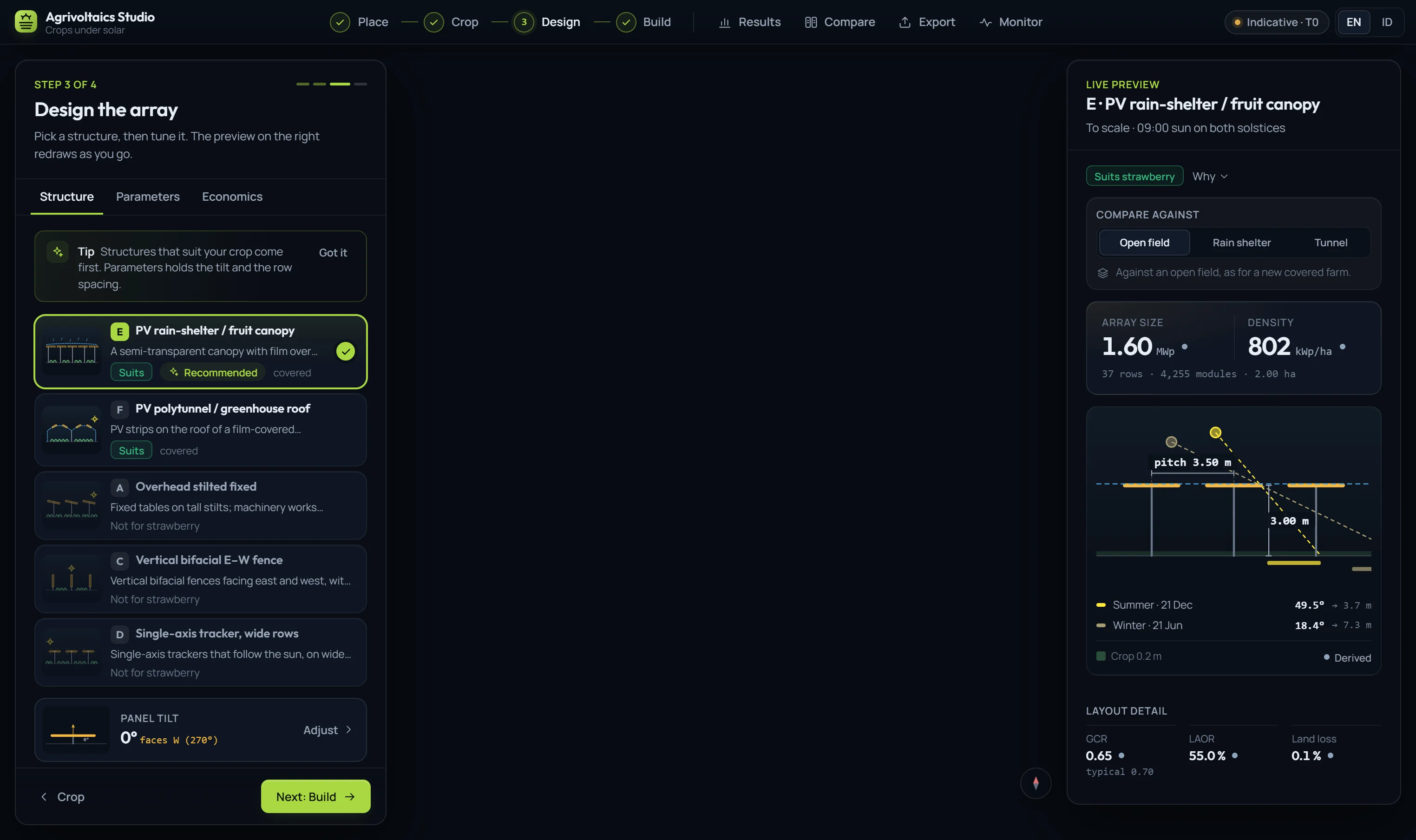
Pick a structure. The preview redraws

The Design step lists all five, ordered by how well they suit your crop, each with a badge: suits, conditional or unsuitable. A to-scale preview shows the shadow at both solstices as you change the structure, the tilt and the row spacing.

Suitability
judged for the crop you picked
Tilt
inside the sourced range
Shortcut
keys 1–5
Design step, left panel: five structure cards ranked for strawberry, each with a suitability badge.
Design step, live preview: the PV rain-shelter drawn to scale with the summer and winter sun angles and how far the shadow reaches.
Fig. 1 · Design step · structure cards and the live to-scale preview
DGive light back

Tracker policy and the light on the ground

Follow the sun for energy, turn the modules edge-on at midday to let light through, or hold them flat. The readout shows what each choice costs and gives.

Fig. 2 · Light under a tracker arrayIllustrative model · drag the time, change the policy
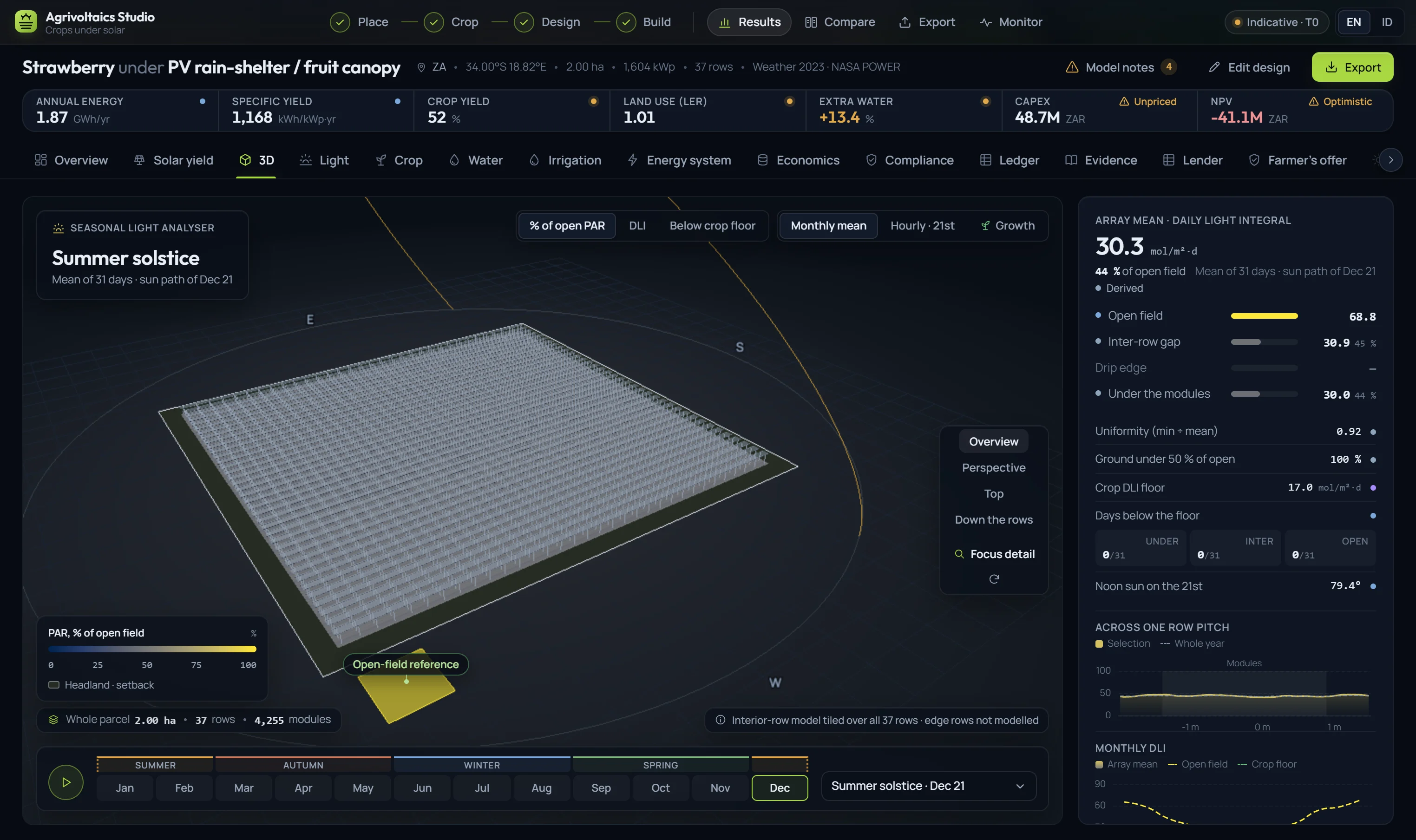
3DWhole parcel

The structures at parcel scale

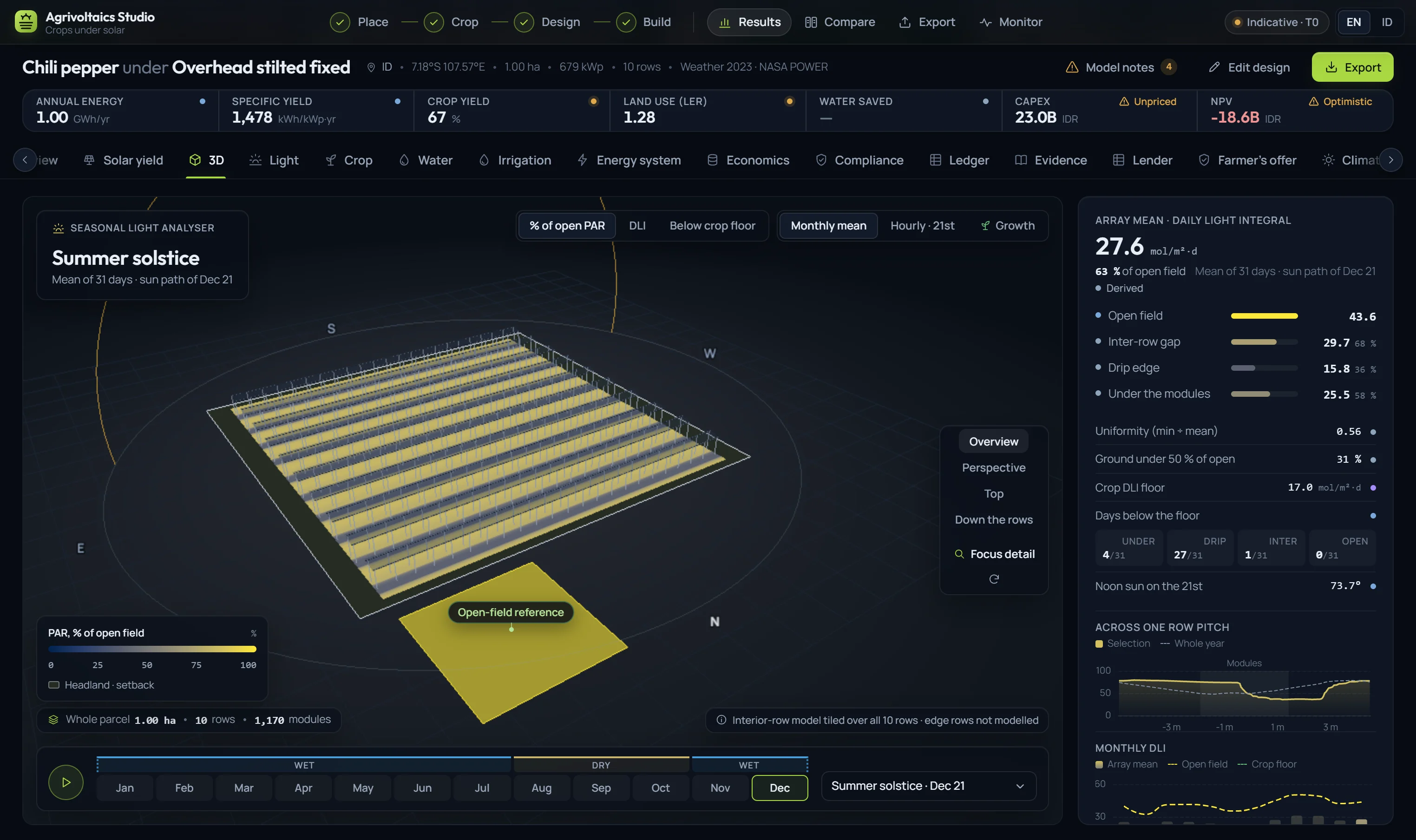
Archetype E over a strawberry site near Stellenbosch in the 3D seasonal light analyser.
Fig. 3 · Archetype E · strawberry · Stellenbosch
Archetype A over a chili site in West Java in the 3D seasonal light analyser, with ground light between the rows.
Fig. 4 · Archetype A · chili · West Java
Not sure which one fits?

Let the studio rank them

Bring a field and a crop. We run all five and show which structure suits it, and what each one costs in light, energy and money.